




INTERNATIONAL INSTITUTE FOR DISASTER RESEARCH
Scientific-Professional Society for Disaster Risk Management in Belgrade founded the International Institute for Disaster Research in Belgrade, in 2020. The main activity of the International Institute for Disaster Research is scientific research work in the field of disaster studies, and it is performed at the Institute whose headquarters are at the mentioned address. The main activity of the Institute is realized through basic, applied, and developmental scientific research in the field of the scientific discipline of disaster risk management. It has several departments: 1. Department for phenomenology research, endangerment, and resistance to disasters; 2. Department for Disaster Preparedness and Mitigation Research; 3. Department for Disaster Protection and Rescue Research; 4. Disaster Recovery Research Department; 5. Disaster Risk Management Department; 6. Department for Research on International Cooperation and the Legal Framework for Disaster Risk Reduction. The scientific activity of the Institute is carried out in accordance with the Law on Scientific and Research Activity of Serbia and the established and adopted program orientation of the work.The Institute fosters innovation and collaboration, aiming to enhance disaster resilience through scientific research and practical solutions. It actively engages in international projects and partnerships, contributing to global disaster risk reduction efforts. With a multidisciplinary approach, the Institute bridges the gap between science, policy, and practice, striving to create safer and more sustainable communities. The Institute is led by Prof. Dr. Vladimir M. Cvetković (https://vladimircvetkovic.upravljanje-rizicima.edu.rs/), whose expertise in disaster risk management ensures the highest standards of scientific excellence and practical relevance.
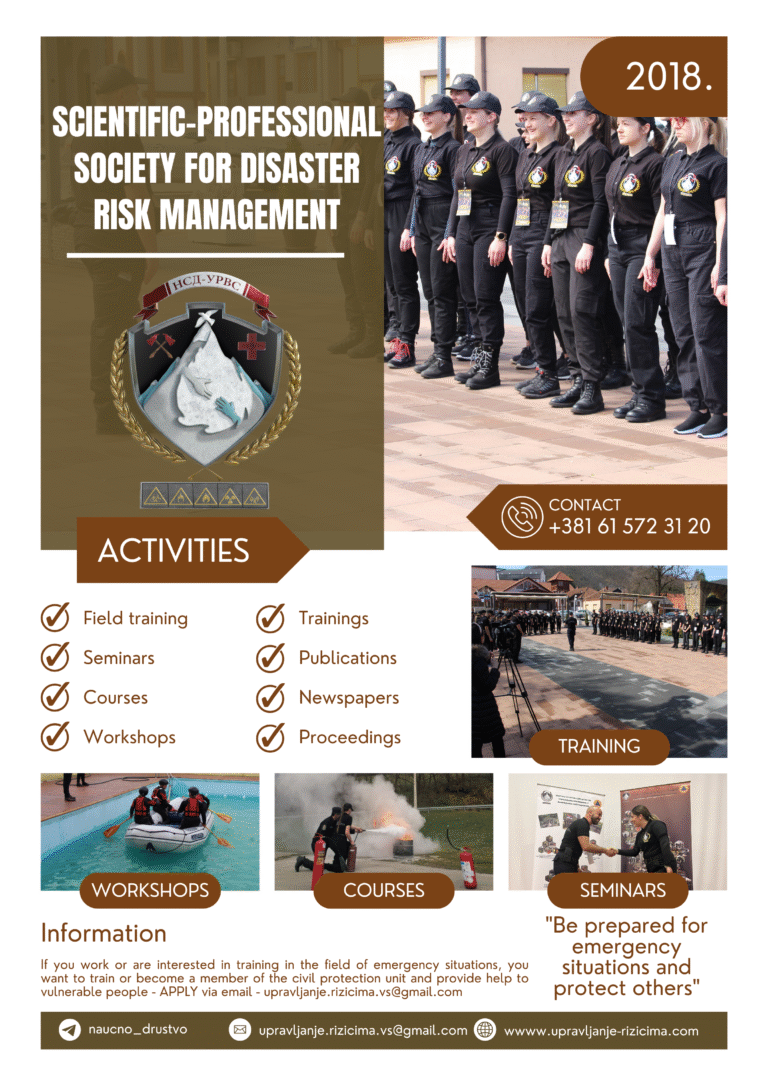
The Scientific-Professional Society for Disaster Risk Management (SPS-DRM) is a dynamic, non-governmental, non-profit organization dedicated to advancing the field of disaster risk management. Established for an indefinite period, our mission is to elevate the theoretical knowledge base, conduct cutting-edge quantitative and qualitative research, organize impactful national and international conferences, launch and manage academic journals, deliver comprehensive training programs, and perform thorough risk assessments, along with other academic activities in this vital field. Recognizing the immeasurable importance and pivotal role of non-governmental organizations and civil society in disaster risk management, including their proactive contributions to public policy, risk reduction actions, advocacy for enhanced preparedness and resilience, aid to affected individuals, and collaboration with emergency response services, Prof. Dr. Vladimir M. Cvetković founded NSDR-URVS on June 15, 2018. This organization unites scientists and practitioners from Serbia and the region to collectively advance theoretical and empirical principles and support local decision-makers and leaders in managing disaster situations effectively.
The Scientific-Professional Society for Disaster Risk Management (SPS-DRM) is led by President Prof. Dr. Vladimir M. Cvetković. SPS-DRM boasts a diverse membership of over 1,500 individuals, including professors from all state and private universities and faculties in Serbia, scientific researchers, practitioners (such as members of the police force, fire and rescue units, emergency medical services, military, and security-related NGOs), as well as students and young professionals directly or indirectly involved in research and practical activities related to emergency situations. Membership is open to all interested individuals and can be obtained by filling out the application form available on our website and submitting it via the Society’s email. Join us and be part of a vibrant community dedicated to advancing the field of disaster risk management. To further enhance our scientific endeavors, on December 21, 2020, we adopted the Statute and established the International Institute for Disaster Research. This institute serves as a hub for basic, applied, and developmental scientific research in disaster risk management. Our research spans various crucial areas, including disaster and hazard phenomenology, preparedness and risk mitigation, protection and rescue operations, disaster recovery, international cooperation, and legal frameworks related to disasters. We are committed to exploring innovative solutions and sharing our findings to build a safer, more resilient world.
The Scientific-Professional Society for Disaster Risk Management (SPS-DRM) is committed to achieving several key objectives. Firstly, it focuses on conducting research in the field of disaster studies. This includes undertaking comprehensive studies to understand the various facets of disasters and their management. Secondly, the Society aims to establish and manage an international journal, specifically the International Journal of Disaster Risk Management, to facilitate the dissemination of research findings and advancements in the field. Additionally, SPS-DRM is dedicated to preparing, applying for, and implementing national and international projects on various aspects of disaster risk management. This involves collaborating with various stakeholders to secure funding and support for impactful projects. The Society also prioritizes the promotion, design, implementation, and improvement of preventive measures against disasters, ensuring communities are better prepared and resilient. Another crucial objective is raising public awareness.
ProSafeNet – The Global Hub for Safety, Security, Risk & Emergency Professionals and Scientists.
ProSafeNet is the global hub for professionals and scientists in safety, security, risk management, and emergency response. More than just a platform, ProSafeNet is a space where experts from around the world come together to share knowledge, enhance preparedness, and lead coordinated action during times of crisis. Built by professionals, for professionals, it is designed to enable better decisions, faster responses, and stronger collaboration. Prof. Dr. Vladimir Cvetković, a leading expert in disaster and emergency risk management in Southeast Europe, founded the platform. ProSafeNet is the result of years of academic research, operational experience, and international cooperation. It combines tools, content, and community into one intelligent digital ecosystem dedicated to a safer and more resilient world. We face an era of complex and global threats—ranging from pandemics and climate-induced disasters to cyberattacks, hybrid crises, and systemic vulnerabilities. Yet, the international safety and emergency community often remains fragmented, without real-time tools for connection, learning, and joint action. ProSafeNet is designed to address this challenge by bringing together professionals and institutions in a single, secure, and collaborative environment. The mission of ProSafeNet is to build a smarter, safer, and more connected world. It supports professionals across disciplines—emergency responders, security specialists, policy-makers, researchers, trainers, and humanitarian actors. The platform provides access to expert content, operational tools, decision support systems, and training modules, all in one place and on demand. Key features of ProSafeNet include personalised user and organisation profiles, scientific publications, risk analyses, professional forums, webinars, training and certifications, event management tools, real-time mission logs, knowledge databases, digital certificates, job and volunteer opportunities, and secure communication and document sharing.
ProSafeNet is open to a wide and diverse audience, including firefighters, paramedics, police units, crisis managers, civil protection authorities, health emergency planners, academic researchers, humanitarian NGOs, safety consultants, and technology providers. Whether you operate in the field, coordinate from a control centre, teach at a university, or analyze risk trends—ProSafeNet is designed for you. According to Prof. Dr. Vladimir Cvetković, “Throughout my career in disaster and emergency risk management, I’ve worked with extraordinary professionals across the world. However, what I’ve consistently seen is that we lack a central, smart, and secure space to connect and collaborate truly. That’s why I founded ProSafeNet—to bring together tools, science, and people into one trusted digital space where we can build, learn, and respond better together.” ProSafeNet welcomes verified professionals, organisations, and students working in safety, security, crisis management, civil protection, public health, and related fields. Early users receive free access to all core features, with optional future premium tools available. The platform prioritises user security and adheres to strict ethical and technical standards to protect all content and communication. Members are encouraged to contribute their knowledge by publishing articles, hosting training sessions, organising webinars, launching collaborative projects, or forming specialised working groups. ProSafeNet is community-driven—your expertise shapes its value. Join ProSafeNet today — it’s free, and become part of a global movement dedicated to protecting lives, infrastructure, and the environment. 🌐 https://prosafenet.com
A project by the Scientific-Professional Society for Disaster Risk Management – © 2025 ProSafeNet – All rights reserved.


International Journal of Disaster Risk Management
The International Journal of Disaster Risk Management (IJDRM) is a double-blind, peer-reviewed (twice a year), open-access international journal that serves all aspects of disaster and hazard studies, policy, and management. The journal provides a platform for academics, policy-makers, practitioners, and humanitarian actors to publish high-quality contributions concerning both natural hazards and disasters (e.g., earthquakes, floods, hurricanes, tsunamis, pandemics) and man-made or technological hazards (e.g., terrorism, cyber-attacks, industrial accidents, hazardous materials, technological failures), as well as complex emergencies and global crises. IJDRM aims to foster dialogue and collaboration across disciplines to mitigate disaster risks and enhance resilience within the broader framework of sustainable development and planetary boundaries. We welcome research that addresses the full cycle of disaster risk management — including prevention, preparedness, response, recovery, and mitigation — at all scales and across diverse contexts.
The International Journal of Disaster Risk Management (IJDRM) publishes interdisciplinary research and practice-oriented studies across a broad spectrum of disaster and crisis-related topics. The journal’s scope encompasses, but is not limited to, the following thematic areas: It explores disaster and crisis management theory and practice, including conceptual frameworks, evolving paradigms, and practical approaches for managing diverse hazards. Risk awareness, perception, and assessment are key themes that address public perception, risk communication, early warning systems, and decision-making under uncertainty.
The journal also focuses on hazard and vulnerability analysis, offering methodologies and case studies on physical, social, economic, and environmental vulnerabilities, as well as multi-hazard risk assessments. Knowledge development and capacity building is another core area, encompassing disaster education, training, public awareness, research innovation, and knowledge dissemination. Articles may also examine public commitment and institutional frameworks, such as legal, policy, organisational, and community-based mechanisms for risk governance and stakeholder coordination. The journal encourages contributions to disaster prevention, mitigation, response, and recovery planning, particularly integrated strategies and best practices at local, national, and international levels. It also covers critical infrastructure protection and continuity planning, focusing on the resilience of essential services before, during, and after disasters.
In light of global challenges, climate change adaptation and environmental risks are a central concern, including the integration of nature-based solutions in disaster risk reduction. The journal devotes significant attention to health, mental health, and humanitarian response, with a focus on emergency medical services, psychosocial support, and public health resilience. Lastly, IJDRM addresses the social dimensions of disasters, highlighting issues of equity, inclusion, gender, culture, and the roles of vulnerable groups and civil society in disaster risk reduction and recovery.
Prof. Dr. Vladimir M. Cvetković is the Founder and President of the Scientific-Professional Society for Disaster Risk Management (SPS-DRM), established in 2018 with the aim of promoting scientific excellence, interdisciplinary cooperation, and institutional capacity building in the field of disaster risk management.
Under his leadership, the Society has grown into a national and regional leader in research, education, training, and policy support related to disaster preparedness, risk reduction, emergency response, and resilience building. His vision continues to guide the Society in connecting science with practice and strengthening risk governance across all sectors of society.
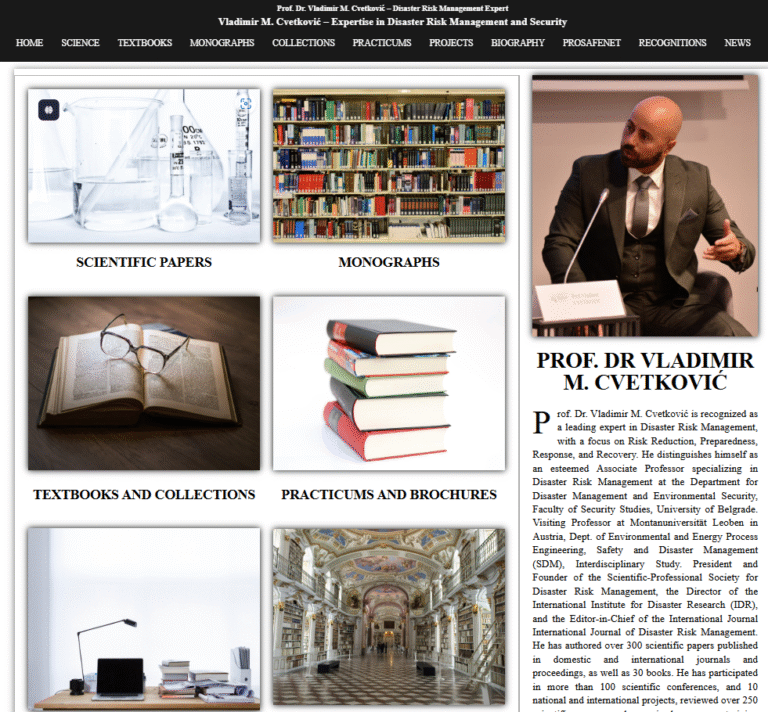
Prof. Dr. Vladimir M. Cvetković is recognized as a leading expert in Disaster Risk Management, with a focus on risk reduction, preparedness, response, and recovery. He currently serves as an Associate Professor at the Department for Disaster Management and Environmental Security, Faculty of Security Studies, University of Belgrade, where he specializes in disaster risk management. He is also a Visiting Professor at Montanuniversität Leoben in Austria, at the Department of Environmental and Energy Process Engineering, within the interdisciplinary Safety and Disaster Management (SDM) program.
Prof. Dr. Cvetković is also the Director of the International Institute for Disaster Research (IDR), founded in 2020, which serves as a center for scientific inquiry, education, and applied research in disaster studies. In addition, he is the Editor-in-Chief of the International Journal of Disaster Risk Management, a peer-reviewed academic journal that fosters global dialogue on disaster-related topics. He has authored over 300 scientific papers published in both domestic and international journals and conference proceedings, and is the author or co-author of 30 academic books. He has participated in more than 100 scientific conferences and contributed to 10 national and international research projects. He has reviewed over 250 scientific manuscripts and has organized numerous professional training sessions and seminars in the field of emergency protection and rescue.